

Mahşere Yanıt, 2023, kumaş üzerine karışık teknik, 149x 57 cm
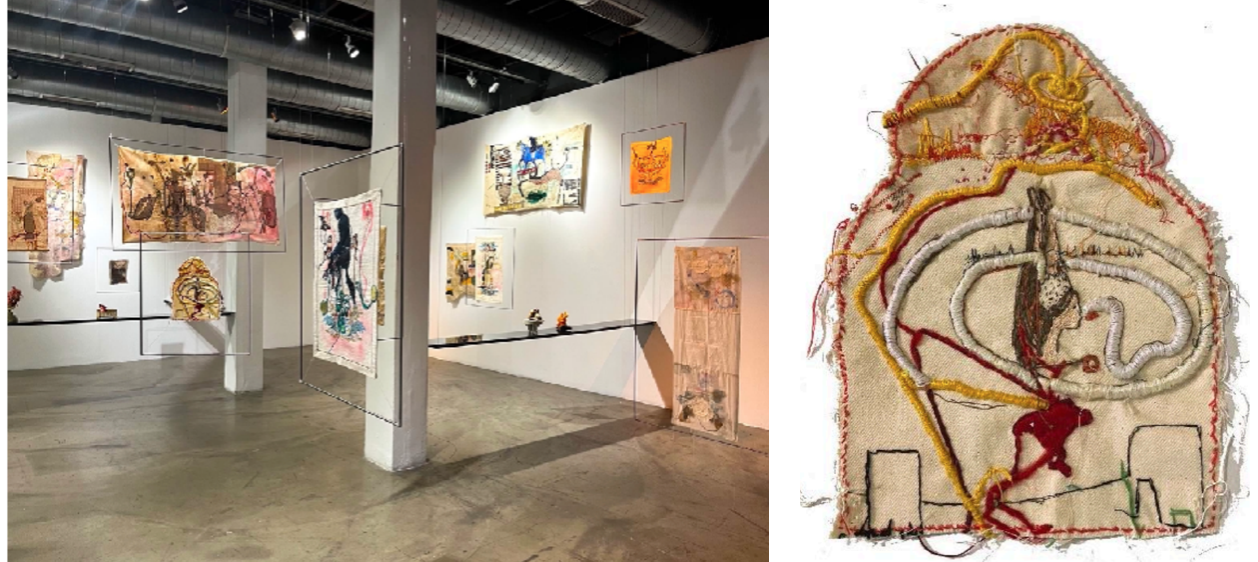
The snake that no one can speak about,
2022, mixed media on fabric, 19 x 18 cm

site-specific installation
DEPO / TÜTÜN DEPOSU Spaces, İstanbul

Envisioned Death For The First Time
2022, mixed media on fabric, 159 x 95.5 cm

Reca,
2023, mixed media on fabric, 48,5 x90 cm

Inutterable Damnations,
, 2022, mixed media on fabric, 29x36cm

Where should it divide
2022, mixed media on fabric, 29x36 cm

Chimera-Flesh
,2023,Mixed media fabric, 20x31,5cm
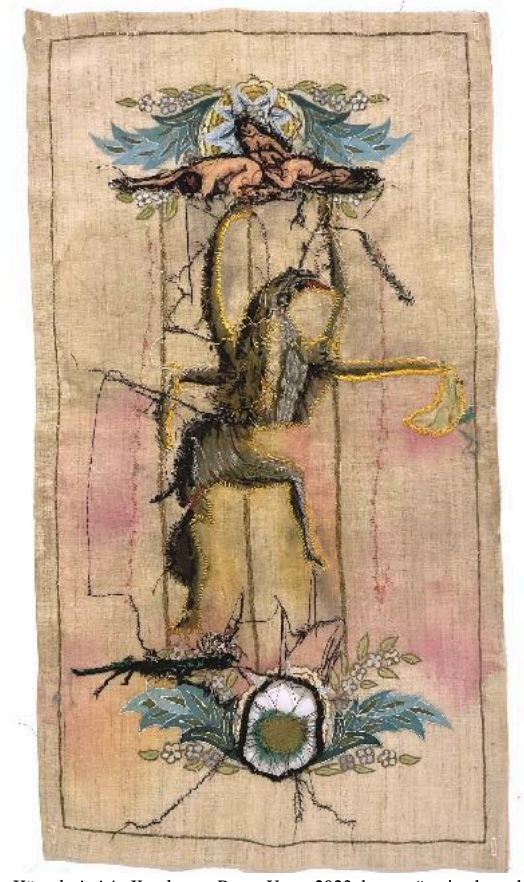
Dance to doors of our cells, wake up
2023, mixed media on fabric, 63 x 34 cm

Two blind lovers, tied to all darkness
2023, mixed media on fabric, 53 x 66 cm

The palpable aspect of fear,
2022, mixed media on fabric, 25 x 19 cm

The ghost is hiding in between the strainds of your hair,
2023, mixed media on fabric, 45x 63

Mutually Rough-Handled Bodies,
2022, mixed media on fabric, 19 x 25 cm

Raksodia,
2023, mixed media on fabric, 19.5 x 40 cm

We called out to you, but you didn't hear
, 2022, mixed media on fabric, 44 x 35 cm

site-specific installation, Depo /Tütün Deposu, İstanbul
Farewell House, 2022, mixed media on fabric, 24 x 22.5 cm

The life on my bedside
mixed media on fabric, 38 x 38 cm

Used to run to the fields taking my face,
2022, mixed media on fabric, 17 x 20 cm

Discovered ground,
2022, mixed media on fabric, 23.5 x 18.5 cm
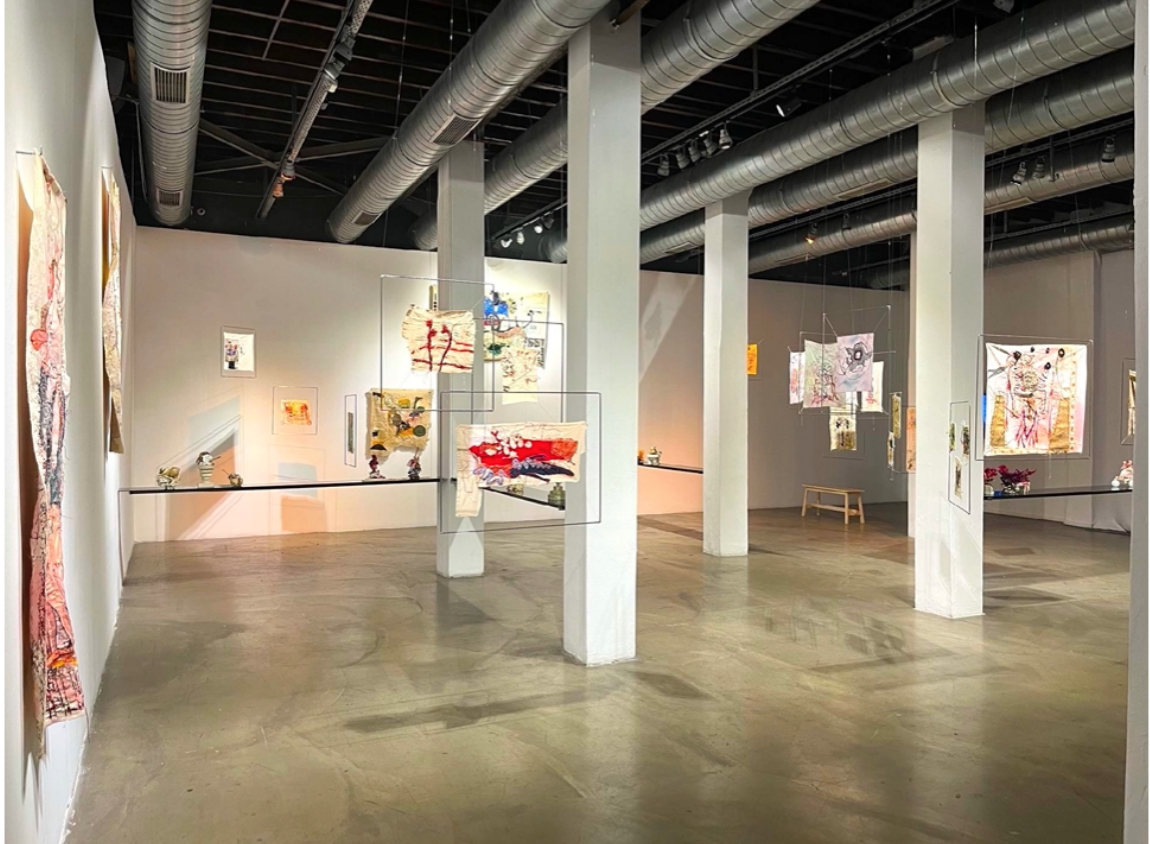
site-specific installation
Depo/Tütün Deposu, İstanbul

Used to run to the fields taking my face
2022, mixed media on fabric, 17 x 20 cm

Let the feet get cross
2022, mixed media on fabric, 24 x 21 cm

site-specific installation
Depo/Tütün Deposu, İstanbul

In between the flickering fires
2022, mixed media on fabric, 27 x 59 cm

The Wings That Ascend From The Back of The Whipped Gods
,abric and clay, 2023,12,5x12,5x18 cm

And,
2022, mixed media on fabric, 77x 228 cm

She suddenly shivered assume all disguises clandestinely
2023 fabric, clay, concrete,17x17x17cm

The Initial Step Towards The Other,
2023, fabric, clay and concrete, 19x 20 x 22 cm

Scarred red in between my hands,
2023, fabric, concrete, 22 x 12.5 x 14 cm

The dizziness digs deep,
2023, fabric, clay, 22 x 23 x 18 cm

For Another One, 2023,
fabric, clay, concrete, bone,17 x 16 x 18 cm

For Another One
2023, fabric, clay, concrete, bone,17 x 16 x 18 cm

Aren't we the ones who wake up with dances
2023, fabric, clay, bone, 13.5 x 16 x 16 cm

Aren't we the ones who wake up with dances
2023, fabric, clay, bone, 13.5 x 16 x 16 cm

The last white knob beneath my feet,
2023, fabric, clay and concrete,22,5x21,5x9,5

Else the first step that dreams,
2023, fabric, clay, concrete, 28.3 x 13 x14 cm

Diamond Jack
2023, fabric, clay, concrete, bone, 32.5 x 18 x 18 cm

The yellow within me burst out,
2023, fabric, clay, concrete, 18 x 16 x 14 cm

By apprortioning barren tranquility
2023,fabric,clay,concrete, 21x20.5x16cm

site-specific installation
Depo, Tütün Deposu, İstanbul

Bursting from the collarbone to our hands
2023 fabric and clay 241x57x5cm

drawing installation
Depo/Tütün Deposu, İstanbul

I walked away
, 2021, kağıt üzerine karakalem, 29.5 x 29 cm

Love
, 2021, drawing on paper, 33 x 24 cm

Take the eyes out of the last swift jot
, 2021, drawing on paper, 29.5 x 21 cm

The upside down feather tree,
2021, drawing and watercolor on paper, 23.5 x 33 cm

In taberna quando sumus
, 2022, drawing on paper, 28 x 35 cm

Built for keeping each other alive,
2022, drawing on paper, 24 x 33 cm

site-specific installation
Depo,Tütün Deposu, İnstanbul


Loading Viewer...
Long Live the Monster!
I went to Çınar Eslek’s studio around the days when my body started to return to the state I remembered before. I marveled at how much my body could expand in just a few months, and I tried to shake off the turbulent winds of hormones. Uncovering day by day unfamiliar aspects that my body can assume, dedicating it to someone else to live in and be fed from for a period, and engaging in a symbiotic relationship that you know will end but you don’t know how long it will last is a prolonged transformation. The pregnant woman’s body, seen as the source of both creative potential and social anxiety from when the female body was thought to be the incomplete and defective version of the male body until recently, has been surrounded by cultural fear and admiration. Pregnant women have often been depicted as monstrous figures in literature and popular culture due to their transformative and unpredictable nature. This portrayal of monstrosity stems from society’s discomfort with the unknown and uncontrollable aspects of female reproduction. During this period of experiencing various stages of monstrosity, I encountered the fabric works in Tack, Limb, Ilizarov. Before me stood an array of “monsters,” composed of interlocking human, animal, and plant components, each delineated by distinct colors yet with elusive boundaries, all brought together through intricate stitching.
In her fabric works, each containing a unique ecosystem, Eslek skillfully tacks together a blend of fictional imagery, recollections from her childhood, and dreamscapes. Tacking serves as a mode of thought and production for her. The artist’s perspective, recognizing humans as an integral part of nature rather than claiming species superiority and refusing to become normative, is distinctly evident in her works on found fabrics. Eslek’s narratives, ranging from her relationships with her body and its environment to some of her propositions on existence, unfold within surrealist worlds inhabited by hybrid, manifold, and porous beings. Arms, branches, roots, tails, legs, and heads are tacked/ articulated non-hierarchically, forming Eslek’s world of monsters. It is evident that the monsters that the artist conceives, gets inside-places one inside, thinks about-dreams of-inspires others to dream about, are pluralistic and constructive, and point to a collective formation and life. Eslek, as it were, returned to the essence of the word “monster,” stripping away the negative connotations time has imposed upon it. The term canavar, meaning monster in Turkish, originates from Persian and was derived by adding the suffix “var” (to have) to the word “can” (life) and means a living being, a creature. The equivalent of the word “monster” in Ancient Greek is “τέρᾰς/téras,” meaning marvel, wonder, potent, divine sign, omen. It is used for beings that elicit both admiration and fear. This fear is a product of an androcentric and heteronormative thought system that separates those perceived as different.
The most renowned monster whose disparate limbs are stitched together is undoubtedly the one created by Doctor Frankenstein. In the novel based on humanity’s curiosity about immortality and, on the other hand, the zeal to create human beings not born of women, especially within the male-centered thought system (consider all the mythological Greek gods and many laboratory studies), the wishes of Doctor Frankenstein’s monster are aimed at happiness as a living being, and not being alone. However, he is met with fear and avoidance due to his unconventional appearance. The full title of the novel is Frankenstein or the Modern Prometheus. While some myths depict Prometheus as the creator of humans from clay, he is more widely recognized as the titan who gave humanity the fire that represents technology and civilization by stealing it from the Olympian gods and who watches over humanity. In the title of Mary Shelley’s novel, Prometheus represents human exaggeration in his search for scientific knowledge and the risk of unintended consequences. In the present era, humans are increasingly drawn to a dual aspiration. On the one hand, they are inclined to reconnect with nature. On the other hand, they harbor a unique existential ambition—to prolong their lives, attain immortality, and perfect their physical and cognitive abilities. This fascination with redefining human potential drives the development of artificial intelligence-supported solutions and research initiatives spanning the human body’s and deep space’s far reaches.
Bernard Stiegler, one of the philosophers who extensively studied the human-technology relationship, does not consider humans independently of the fire, that is, technic, that Prometheus gave them. Through technology, individuals acquire capabilities they do not have. Thus, humans unveil new potentials by prosthetizing with technics that is the externalization of the memory and an extension of the body. However, according to Stiegler, every technic or technology is a “pharmakon”. It can be both a cure and a poison in the sense that it brings both solutions—curative power, and potential new problems—destructive power. Coming from the Western system of thought, Stiegler cannot help but define good and bad, and separate the two. Conversely, philosopher Yuk Hui advocates embracing diversity rather than adhering to such dualities. He states, “Even if we have common problems we are trying to solve, there is no single way to respond to the collapse of ecosystems. We must understand that variation is a consequence of local adaptation.” Similarly, technological diversity allows for different solutions to common problems, such as those within the realm of health. However, dominant perspectives can lead to monopolies. Nonetheless, localized healing can yield on-site and internally tailored solutions to adapted problems. As explored in Çınar Eslek’s works, these healings can be made possible by articulating and multiplying, acknowledging imperfection, and embracing.
techniques that do not objectify the body or create the illusion of completeness. In the video work Surface (Prolog) (2019), the artist delves into an earlier chapter in her life, revealing her body’s connection with the fields and hills, where she gathered images for her fabric works, all through the act of walking. We witness that the foot closely observed on the bed is an extension of a leg that once limped when touching the ground, a leg that traveled a long way on the dry grass with support from another body and went to a healer. These four legs have become one, embarking on a shared journey. Even though the lame leg is fused with the olives in the hands of the healer, it still relies on the back of its companion on the way back. The harmonious movements of these two individuals, who communicate without words, and the synergy of their bodies shine amidst the vast steppe. Eslek creates space-bodies with organic and inorganic materials such as bones, concrete, fabric, seashells, and porcelain that she has accumulated over time, based on the relationships her body establishes with the earth and spaces, hybridization, ruptures, and reunions. This exploration of space-body construction extends from the sculptures into the artist’s video titled Oh White (2023), which delves into the hybridization between the artist and a hospital building—an experience rooted in a period spent with another “technic,” Ilizarov, at Baltalimanı Bone Hospital. The imagery peering into the depths of the building and Eslek’s skeleton, excerpts from the artist’s diaries, and fragments from the story “Concretion” penned by author Bihter Sabanoğlu specifically for this work are tacked together. The combined transformations of the building and the artist’s body often bring about shifts in time and space. “I have started to feel to the marrow each stone of the building. The doctors transfixed the tool they mentioned into my leg. They also placed other things in my joints in other parts of my body. I am grateful that Reshid Pasha prevented this building to be built out of wood. Otherwise, how would its wooden trunk fuse with my artificial body?” The proximity of Çınar Eslek’s body propositions to themes of posthumanism is quite remarkable. In particular, the potential scenarios of becominganimal, as explored by Rosi Braidotti concerning the end of the centrality of man, becoming-earth, and eventually becoming-machine in the context of human-technology relationships, open the door to an ever-evolving narrative within the exhibition. In Tack, Limb, Ilizarov Eslek embraces a queer perspective as an expansive lens to challenge prevailing narratives, offering a comprehensive rethinking and reconstruction of bodies, spaces, and times. This approach scrutinizes the constructed aspects of the present and fosters the emergence of diverse and multifaceted futures. Here’s to the days when we proudly proclaim, “Long live the monster!”
1. Rosi Braidotti, “Mothers, Monsters, and Machines,” in Nomadic Subjects: Embodiment and Sexual Difference in Contemporary Feminist Theory, 2nd ed. (New York: Columbia University Press, 2011), 213–44. 2. Bernard Stiegler, Technics and Time, 1: The Fault of Epimetheus, trans. Richard Beardsworth, George Collins (Stanford: Stanford University Press, 1998). 3. Yuk Hui and Anders Dunker, “On Technodiversity,” in The Milk of Dreams Vol 1. (Venice: La Biennale di Venezia, 2022), 553-60. 4. See Bihter Sabanoğlu’s story “Concretion” at the exhibition. 5. Rosi Braidotti, The Posthuman (Cambridge: Polity Press, 2013), 55-104.
Ceren Erdem